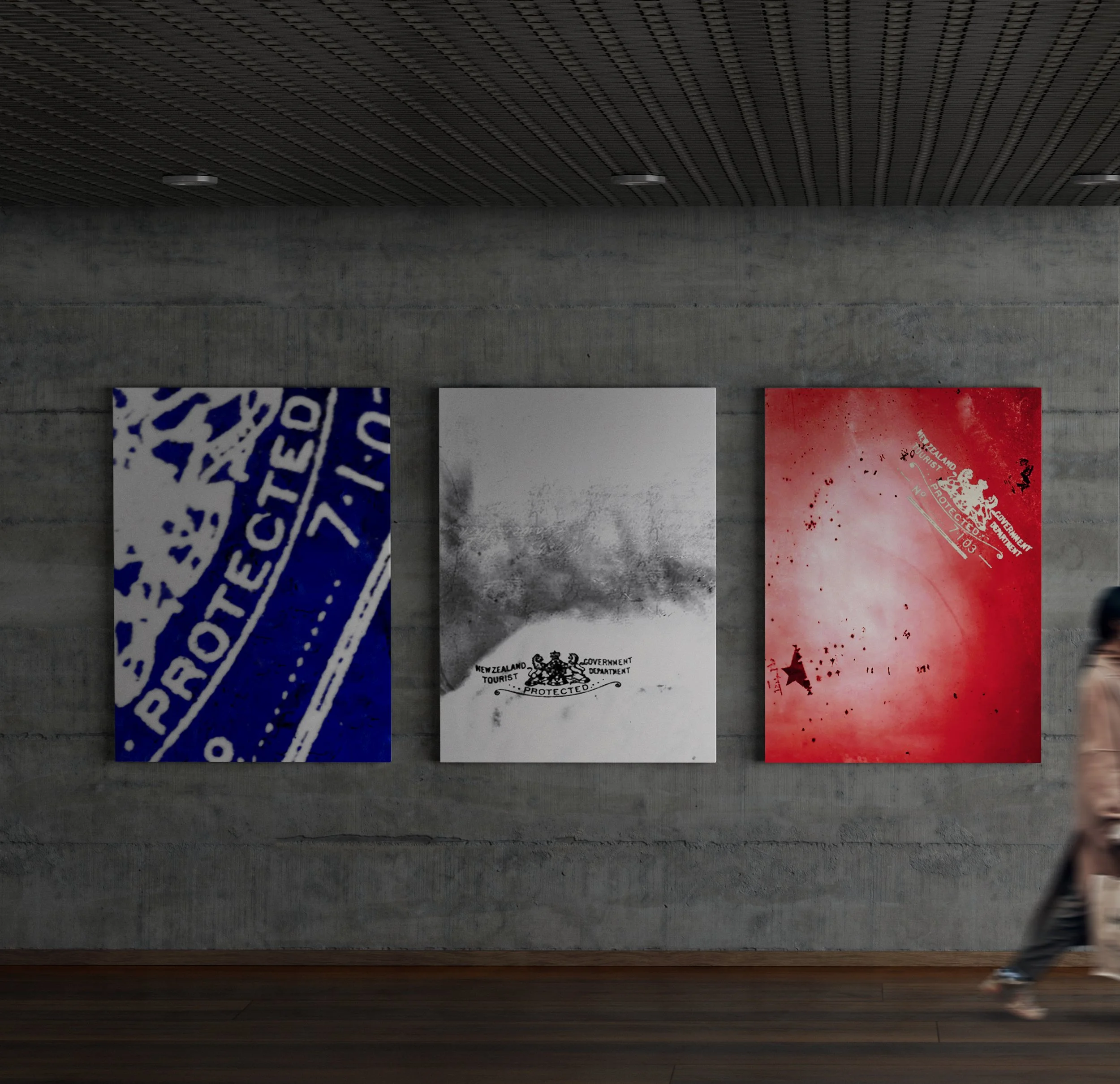
Protected #00 Digital mockup
A critical engagement with colonial histories embedded in archival photographs, those marked by the New Zealand Government Tourist Department stamp, and their ongoing implications for Māori representation, agency, and cultural sovereignty.
Protected
“
Photography was extensively employed in the late 19th and early 20th centuries to depict Pacific Islanders, including Māori, often framing them within colonial narratives that emphasised exoticism and cultural otherness.
”
The New Zealand Government Tourist Department played a significant role in shaping the visual representation of Māori culture during the late 19th and early 20th centuries. Photographs of Māori individuals — often stamped or marked by the department — were used to promote New Zealand as a unique travel destination, typically portraying subjects in traditional attire or engaging in cultural practices such as performing the haka or weaving.
While these photographs served as a form of cultural preservation, they were deeply shaped by colonial narratives and the tourism industry's desire to present an idealised and exoticised view of Māori identity. Official stamps on these images signified their endorsement in promotional materials — postcards, brochures, posters. The process of commodification diminished the cultural integrity of these representations while stripping agency from the Māori individuals depicted, turning them into passive subjects within a commercialised narrative.
METHODS, ETHICS & CRITICAL FRAMEWORK
The New Zealand Government Tourist Department commissioned or utilised several photographers to capture images of Māori people for promotional purposes, shaping a visual narrative that blended documentation with colonial and commercial interests. Ownership of these early photographs typically rested with the photographers or the commissioning entities — intellectual property laws of the colonial era did not recognise Indigenous rights, meaning Māori individuals had little control or ownership over their own representations.
Today, such photographs are held in archives, museums, and libraries, sparking ongoing discussions about repatriation, heritage, and rightful ownership. The need for ethical frameworks that respect Indigenous intellectual property rights remains pressing.
The double meaning of "Protected"
The Tourist Department stamp carries layered, conflicting meanings.
On one level it suggests safeguarding and preservation.
On another, it signifies colonial control, asserting ownership and authority over cultural representations, commodifying Māori imagery under governmental oversight.
PRACTICE & OUTCOMES
In Protected, the Tourist Department stamp is isolated — the Māori individuals originally depicted are removed. This act of removal is not erasure but refusal: a refusal to perpetuate the colonial gaze while still making visible the administrative machinery that sustained it. By intertwining land, archival stamps, and viewer engagement through the reflective surface, the work creates a space where history, identity, and accountability intersect.
The polished metal surfaces mirror the viewer's presence, disrupting passive observation and inviting deeper engagement with the layers of representation and commodification embedded in the original images. The viewer becomes an active participant — implicated in the act of looking.
a variation
THE COMMERCIAL A-FRAME
The footpath sign, and the archive that sold a culture
The same metal prints, taken off the wall and placed on freestanding commercial A-frames.
The A-frame is the most ordinary tool of street-level selling. It stands on the footpath, announces an offer, and asks to be noticed in passing. The Tourist Department used photography in much the same way: to advertise a destination, with Māori people and culture positioned as part of what was on offer.
Here, the stamps are presented on commercial A-frames, returning the archive to the language of advertising it came from. The people are gone. What the viewer is left to read is the claim of ownership itself.
Same logic
Both exist to promote. Photograph and signboard each turn something into an offer for passers-by.
Same claim
The Protected stamp asserted government authority over Māori imagery and its reproduction, much as a sign says whose it is.
Same exchange
Culture becomes a product, and the people it came from are not party to the sale.
Same street
The frame brings the archive out of the collection and into public space, where the viewer walks past it as they would a shop front.
REFERENCE
Quanchi, M. (2006). Visual histories and photographic evidence. The Journal of Pacific History, 41(2), 165-173.
https://doi.org/10.1080/00223340600826052
ACKNOWLEDGEMENT
With thanks to the Alexander Turnbull Library, Wellington, Aotearoa New Zealand, for their support and access to archival materials.