Play time at the Art Fair.
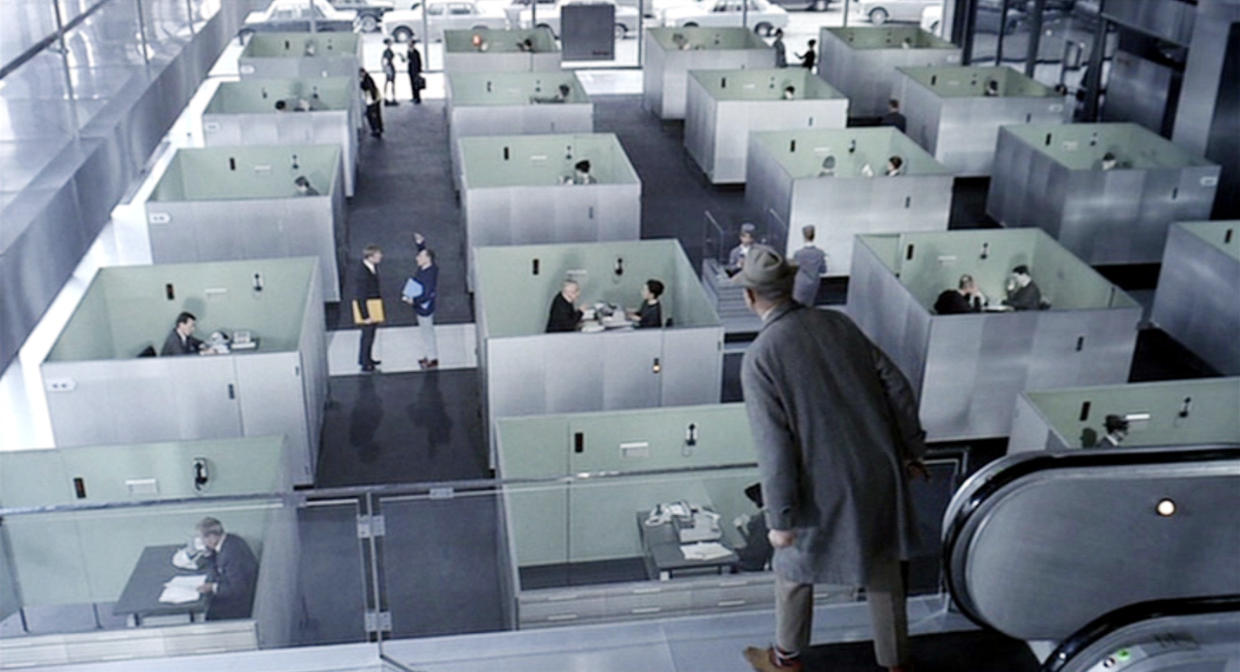
Playtime Jacques Tati, France, 1967.
Every time I walk into an art fair, I feel as though I have wandered straight onto the set of Jacques Tati’s Playtime.
The lighting is too bright, the floors are too shiny, and everyone seems to glide about with a confidence I have never managed to fake.
I am instantly intimidated and slightly out of place, like a misplaced extra who has stumbled into the wrong scene.
My strategy is simple: a brisk tour, almost a trot.
To borrow another cinematic reference, it resembles the famous Louvre dash in Godard’s Bande à part, except I am not running for a record, only for survival.
As I weave through the aisles, I mentally select four or five works I might return to, should I regain my composure. It is entirely subjective, and it has absolutely nothing to do with the art market, which is, of course, the actual point of an art fair.
I avoid the obvious. The big names, the celebrities, the works that have already been seen.
They may be excellent, but I have seen them before, and I need something new to feed my eyes and my brain.
As a photographer, I am always searching for work that genuinely tries something different, whether in its ideas, its materials, or its way of looking.
I tend to sidestep the classic landscapes or portraits whose only distinguishing feature is a quirky accessory worn by a model. If the entire concept rests on a hat, I am not interested.
Nothing wrong, just a personal view.
And yet, despite my mild panic, a few things always amuse me.
Sharpness is a disease
I stand in front of enormous photographic prints, and all I can see is the sharpness.
Why so sharp?
What are we proving?
Even without going full Cartier‑Bresson, I cannot help wondering what value this obsession with perfect clarity actually brings. Must every pore, pebble, and blade of grass be rendered with forensic precision.
At some point, the image stops breathing.
Too much Kiwiana kills the Kiwiana
We are in a rare position here in Aotearoa: we can have a meaningful conversation about the uniqueness of this place. Yet the nostalgia for pre‑1990 New Zealand, its pop‑culture objects, its retro packaging, its sentimental icons, has become so heavy that it smothers the discussion rather than enriching it. A little Kiwiana is charming. A tidal wave of it is anaesthetic.
What surprised me most this year was how drawn I was to the work of young artists.
They seem far less interested in mourning the “good old days” and far more invested in imagining something else entirely.
Their work feels alert, curious, and unburdened by nostalgia.
It was refreshing, and frankly, a relief.
Anyway, one hour later, I am out of the fair, bemused.
