Embalming time: The ghost fabrique.
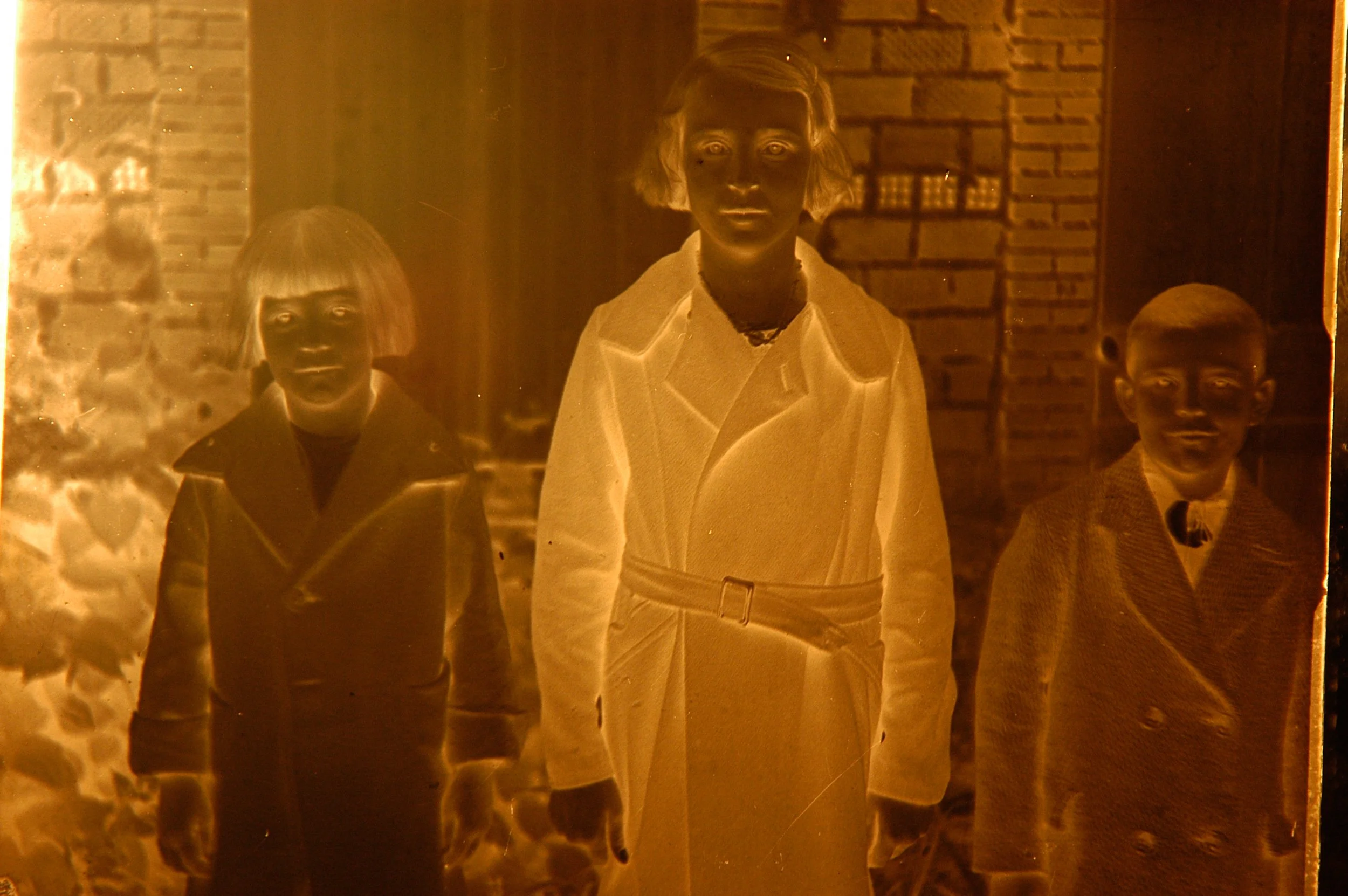
There's a peculiar alchemy that happens in portrait photography, something I've come to think of as the Ghost Fabrique. Every time I press the shutter, I'm not simply capturing light or preserving a moment.
I'm creating a ghost, a double, a trace of someone who will never exist in quite that way again. Even if my subject stands before me minutes after I've taken their photograph, they've already changed. The person in the image is already gone, already haunting us from the past.
This realisation came to me gradually, through years of working with portraits, but it crystallised one afternoon when I was looking through old family photographs.
There was my father, young and laughing, frozen in 1962.
He's been gone for years now, but in that photograph, he's perpetually alive, perpetually twenty-four, perpetually caught in that moment of joy.
The photograph had become a ghost, a presence that marks an absence, something that is here precisely because it is no longer there.
The Spectral Nature of the Photograph
The French philosopher Jacques Derrida wrote about what he called 'hauntology', a concept that plays on the similarity between ontology (the study of being) and haunting. For Derrida, hauntology describes things that are neither present nor absent, neither dead nor alive. They exist in a strange in-between state, like ghosts. When I first encountered this idea, I immediately thought of photographs. What better description of what a photograph does? It makes present something that is absent. It gives us access to a past that no longer exists, yet somehow still persists.
The Polish scholar Marianna Michałowska expanded on this, exploring how hauntology helps us understand our relationship with the past, particularly in contexts of loss and trauma. Photographs, she suggests, are one of the primary ways we negotiate with ghosts, with the traces of what has been. They're not simply records; they're active participants in how we remember, how we mourn, how we maintain relationships with people and moments that have passed.
This isn't a new anxiety. The Victorians understood it too, though they approached it differently. In the mid-nineteenth century, spirit photography became wildly popular. Photographers like William Mumler in America and William Hope in Britain claimed they could capture images of the dead alongside the living. Mumler's most famous photograph showed Mary Todd Lincoln with the ghost of her assassinated husband hovering behind her. These were frauds, of course, double exposures and darkroom trickery. But the fact that so many people believed, that so many desperately wanted these images to be real, tells us something profound about what we've always sensed about photography.
The Victorians were grappling with the same uncanny quality I experience in my work. Photography arrived at a moment when traditional certainties about life, death, and the afterlife were being questioned. Here was a technology that seemed to cheat death, that could preserve the image of a loved one long after they'd gone. Is it any wonder that people imagined it might capture actual spirits? The fraudulent spirit photographs were simply making explicit what all photographs do implicitly: they traffic in ghosts.
Embalming Time, Creating Doubles
The film theorist André Bazin described photography as 'embalming time'. What a perfect, unsettling phrase. Like the ancient Egyptians preserving bodies for the afterlife, photography preserves moments, keeps them from decaying into pure memory and eventual forgetting. But embalming isn't resurrection. An embalmed body isn't alive; it's a preserved corpse, a thing that looks like what it was but fundamentally isn't anymore. Photographs work the same way. They look like life, but they're not life. They're life's preserved remains.
Edgar Morin, the French sociologist and philosopher, took this further. He argued that photography creates what he called 'doubles', copies that have their own strange existence. These doubles aren't simply representations; they have a kind of reality of their own. Think about how we talk about photographs: 'That's a good picture of you' or 'I don't look like myself in that photo'. We treat the photographic image as a separate entity, another version of the person, not just a depiction. Morin suggested that this doubling is fundamentally connected to death. The double is what remains when the original is gone. It's the ghost.
When I'm working with a subject, I'm always aware of this doubling. I'm creating another version of them, one that will outlive the moment, that might outlive them. There's a weight to that, a responsibility. What ghost am I making? What version of this person will persist?
The Ghost Fabrique in Practice
I call my practice the Ghost Fabrique because 'fabrique' captures both the making and the place of making. It's a workshop, a factory, a studio where ghosts are manufactured. But it's also a process, a fabrication in both senses: a making and a kind of fiction. Because photographs, for all their apparent objectivity, are fictions. They're highly selective, carefully framed, lit, and composed. The ghost I create is never the whole person; it's a particular version, a particular angle, a particular moment.
This doesn't make photographs lies, exactly. It makes them something more interesting: interpretations, translations, transformations. When someone sits for a portrait, we're collaborating on which ghost to make. Will it be formal or casual? Guarded or open? Joyful or contemplative? The person in front of my camera is real, present, alive. But the person in the resulting photograph is already a ghost, already a trace, already haunting.
There's a melancholy to this, certainly. Every photograph is a memento mori, a reminder of mortality. But there's also something beautiful, even defiant, about it. We make ghosts because we love, because we want to hold on, because we refuse to let everything slip away into forgetting. The Ghost Fabrique is an act of resistance against time, even though we know time will win eventually.
Living with Ghosts
I have a wall in my home covered with photographs: family, friends, subjects from years of work. Some of the people in those images are still in my life. Some have drifted away. Some are dead. But they're all ghosts now, all traces of moments that have passed. I live surrounded by these spectres, these doubles, these embalmed fragments of time.
Derrida argued that we're always living with ghosts, that the past is never really past. It haunts us, shapes us, speaks to us. Photographs are one of the ways we maintain that conversation with what has been. They're how we keep the dead alive, how we remember who we were, how we mark the passage of time while simultaneously trying to stop it.
The Victorian spirit photographers were frauds, but they weren't wrong about what photography does. Every photograph is a spirit photograph. Every portrait is a séance. In the Ghost Fabrique, I'm not claiming to capture actual spirits, but I am capturing something spectral: the trace of a presence, the mark of a moment, the ghost of someone who was here and now is not.
This is what I think about when I raise my camera. I'm not just taking a picture. I'm performing a small act of magic, a transformation. I'm turning the living into ghosts, the present into the past, the real into the spectral. I'm creating something that will outlast the moment, that will haunt whoever looks at it, that will whisper: 'I was here. This happened. Remember.'
And isn't that, finally, what we all want? To leave a trace, to be remembered, to haunt the future just a little? The Ghost Fabrique is my way of granting that wish, one photograph at a time. Every shutter click is a small act of love and a small act of mourning, a preservation and a loss, a presence and an absence.
We are all, in the end, making ghosts. I've just made it my practice to do so deliberately, thoughtfully, with care. Because if we're going to haunt the future, we might as well haunt it beautifully.
References
Bazin, A. (1960). The ontology of the photographic image (H. Gray, Trans.). Film Quarterly, 13(4), 4–9. https://archive.org/details/Bazin_Andre_The_Ontology_of_Photographic_ImageDerrida, J. (2001). The Work of Mourning. University of Chicago Press.Morin, E. (2005). The Cinema, or the Imaginary Man (E. C. Hughes, Trans.). University of Minnesota Press.